
Rice University, Houston, Texas, 2021-2022
M.S. Space Studies - Engineering Concentration
Graduated: December 2022
Coursework:
-
Solar System Physics
-
Aeronautics
-
R for Data Science
-
Design for Aerospace Systems
-
Professional Development Seminars
-
Orbital Mechanics and Mission Design
-
Science Policy and Ethics
-
Plasma Physics
-
Robotics
-
Program and Project Management
-
Remote Sensing
-
Statistics and Data Science for Engineering Management (Python)
Graduate Coursework
The following includes a few examples of my graduate projects at Rice University.
Robotics - Lazy BRushing AssisTant (Lazy-BRAT)
A fully designed tooth-brushing assistant robot. Final Project, MECH 598.

Here's a link to the project poster PDF:
Orbital Mechanics and Mission Design - Ganymed Asteroid Rendezvous for Property Analysis (G-ARPA)
Final Project and Report Paper - MECH 578
Paper Abstract:
Pulling inspiration from the OSIRIS-REx mission to asteroid 101955 Bennu, the 1036 Ganymed Asteroid Rendezvous for Property Analysis (G-ARPA) mission was designed to determine the feasibility of approaching another Near-Earth Object (NEO) in an optimized manner. The mission was designed to land the OSIRIS-REx spacecraft, with slight instrumentation and fuel modifications, onto asteroid 1036 Ganymed on November 13, 2024. From this heliocentric position and local date, two optimized transfer orbits were designed contingent on a minimal ΔV condition, along with a gravity-assist maneuver about Venus. The hyperbolic excess velocity, the required 1036 Ganymed orbit capture velocity, and the final timeline were then calculated based off the optimized transfer orbits between bodies. The timeline of the mission yielded a total of 305 days, with a launch date of January 13, 2024, from the Kennedy Space Center. The Falcon 9 launch vehicle and Merlin 1D+ Vacuum Upper Stage were selected for G-ARPA, and the finalized optimized mission resulted in a ΔV total of
32.312km/s. 8.6268km/s of this was supplied by the Merlin 1D+ Vacuum upper stage, but for mission completion, ion thrusters with larger magnitudes of Isp would be required. All analyses were conducted in MATLAB, along with the creation of visual displays of the calculated orbital transfers and trajectories.
Here's a link to the PDF of the final paper:
Louisiana State University, Baton Rouge, Louisiana: 2013-2018
B.S. Mechanical Engineering
Minor in Mathematics
Throughout my undergraduate career at LSU, I took a multitude of classes which encompassed all areas of engineering. Additionally, I took the time to explore various humanities, technical electives, and mathematics to diversify my studies.
Relevant Engineering Coursework:
-
Static Engineering Analysis
-
Strengths of Materials
-
Dynamics
-
System Dynamics
-
Kinematics of Machine Design
-
Machine Design
-
Heat Transfer
-
Theory and Design of Mechanical Control Systems
-
Thermodynamics
-
Fluid Mechanics
-
Materials Selection and Analysis
-
Simulation Methods (MATLAB)
-
SolidWorks/Engineering Drawings
-
Instrumentation
Complementary Coursework: Humanities, Technical Electives, Mathematics, and Relevant Additional Coursework
-
Differential Equations and Algebra
-
Multivariable Calculus
-
Applied Algebra
-
Mathematical Methods of Engineering
-
Probability
-
French - Beginner through Intermediate
-
Rocket Propulsion
-
Welding Engineering
-
Electronics and Circuits
-
Thermal Sciences and Systems Laboratories
-
Machine Design Laboratory
Mechanical Engineering Projects
The following includes several examples of my completed coursework at LSU.
CAPSTONE DESIGN: LSU Project #10 - "Cool Motorized Scooter for Teenagers"
St. Lillian's Academy / Sponsors: Elissa McKenzie, Jack Rettig, and Valero

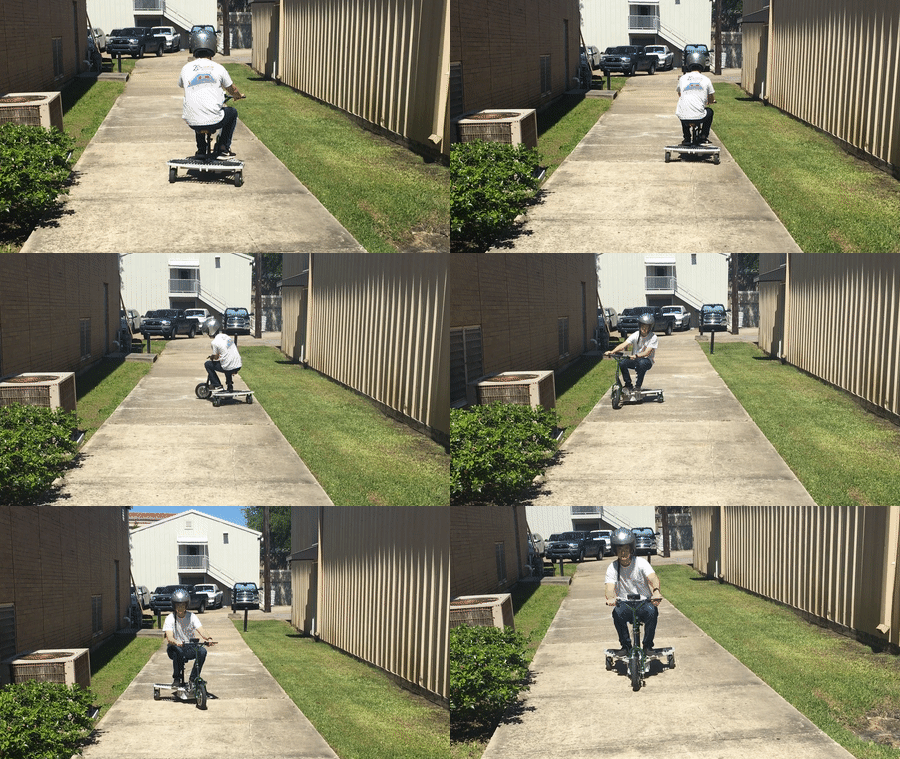
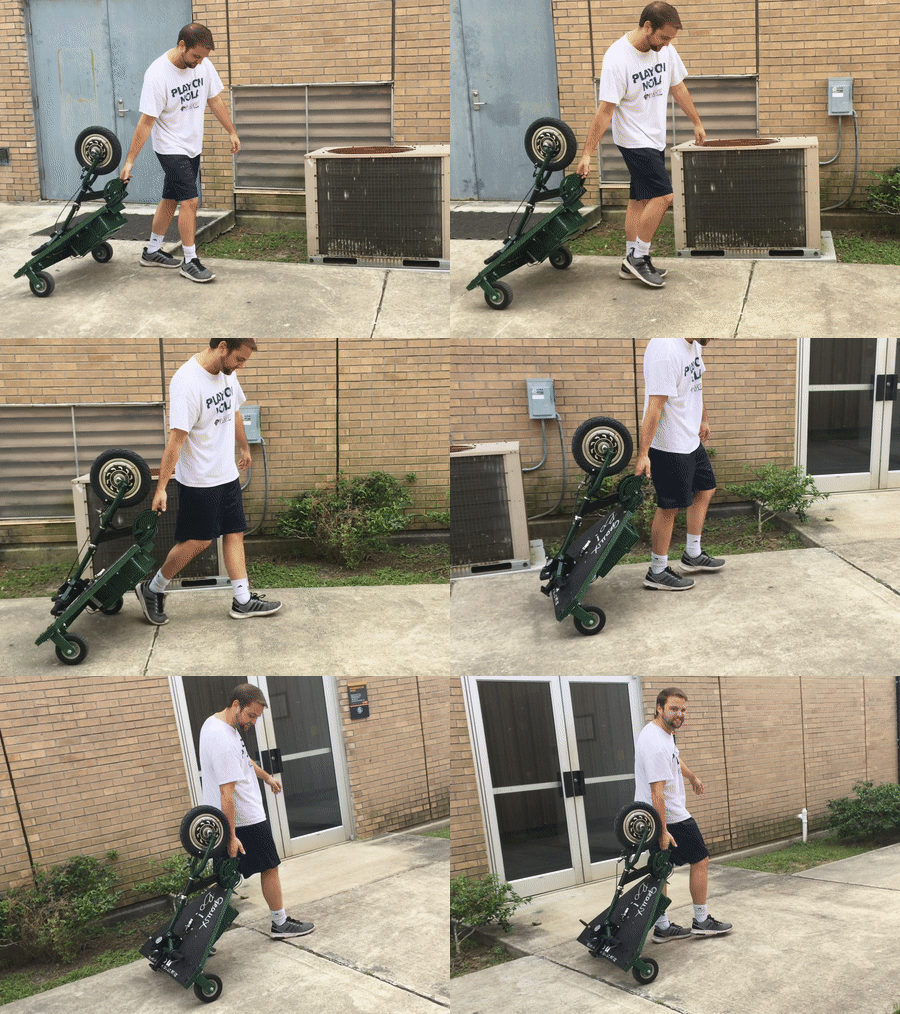
St. Lillian's Academy is a local school in Baton Rouge for students with Learning and Communications challenges. I happily served as the team leader to design and build an electrically charged 3-wheel scooter for a student of St. Lillian's Academy diagnosed with Down Syndrome. The student has limited endurance and required a "cool" scooter to help him participate in daily activities such as going to soccer games, playing at recess, participating in field trips, and alleviating mobility challenges associated with airports and travel.
The "Cool Scooter" weighed a total of 63 pounds, was completely collapsible, and could fit in the trunk of a car. It was designed to roll like a suitcase for easy transport and had a programmed maximum speed of 5mph. The client was extremely happy with the result, and I was very happy to be apart of such a meaningful and challenging capstone project.


HEAT TRANSFER: SPACE SYSTEM RADIATOR DESIGN PROJECT
My final project in my Heat Transfer class consisted of designing a hypothetical radiator for the ISS using a power cycle of our choosing. My team chose a Brayton Cycle and created a unique design that can be viewed in the PDF document below. This was a collaborative project, and my teammates are listed on the cover page.

PDF of Report
THERMAL SYSTEMS LABORATORY: Vibrations Experiment Lab Report
One of the required experiments in my Thermal Systems Laboratory class involved the measurement a system's response to an external force or excitation. It explored the concepts and calculations of natural frequencies, damping frequencies, and damping ratios. My team's final lab report can be viewed below, and my teammates are listed on the cover page.

PDF of Report